How reliable is an HTS code finder on messy Shopify product data?
We tested SkuWatch HTS Code Finder against 100 synthetic Shopify-style listings, including clean titles, brand noise, variant noise, model-only titles, mixed sets, and deliberately vague products.
Short answer: SkuWatch returned the expected broad HTS family for 90 of 92 identifiable listings and correctly stopped on seven of eight ambiguity traps. It missed two identifiable listings and made one suggestion that should have been withheld. A family hit is not proof of a correct ten-digit filing classification.
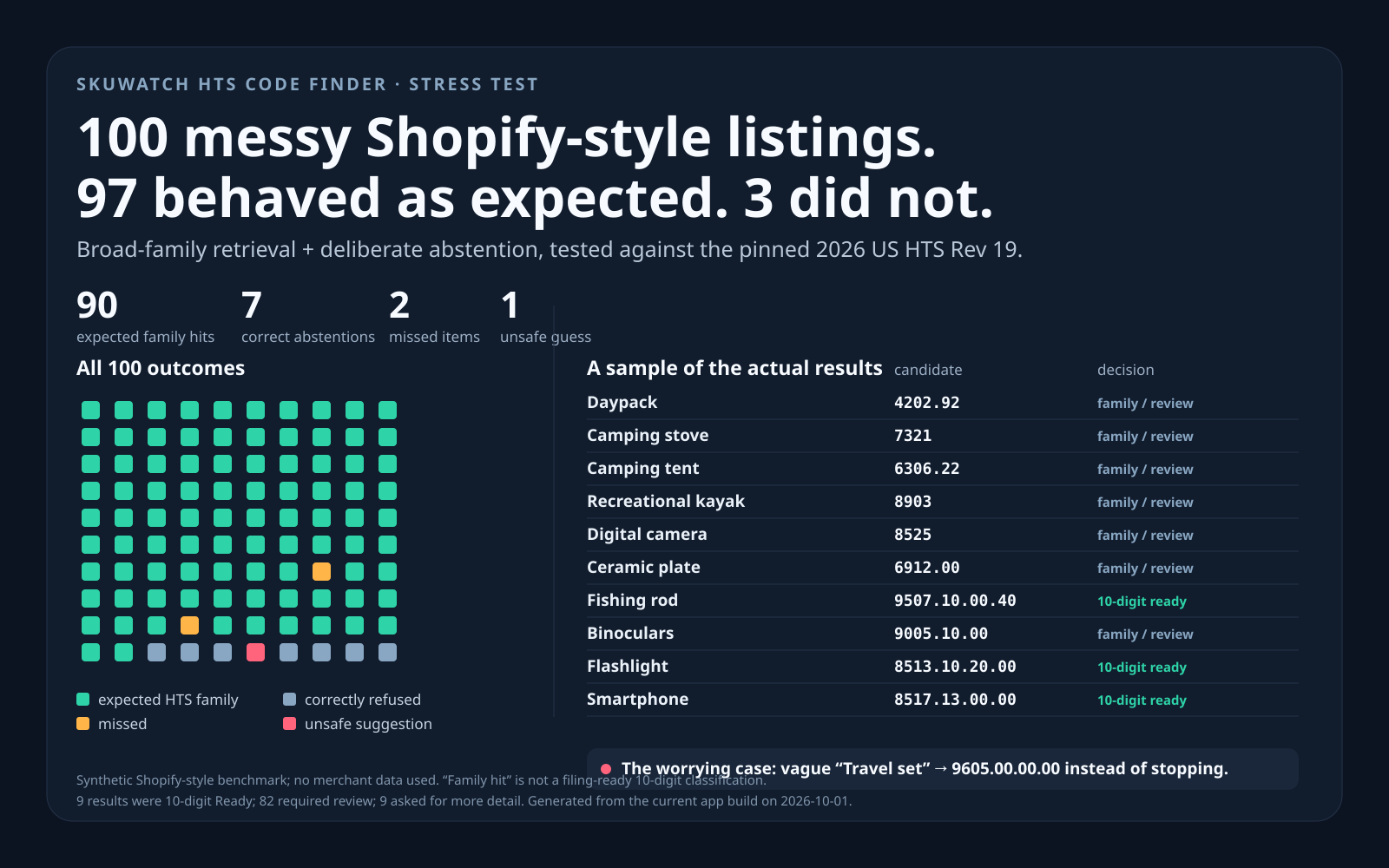
Results at a glance
- 90 expected family hits: the returned candidate began with the expected four- or six-digit HTS family.
- 7 correct abstentions: the listing lacked enough information and the app asked for more detail instead of returning a code.
- 2 missed identifiable listings: model-only titles for a hand tool and a smartphone were not recovered even though the product type and description contained useful facts.
- 1 unsafe suggestion: the vague listing “Travel set” produced 9605.00.00.00 instead of stopping to ask what the set contained.
The app's workflow states were separate from those benchmark outcomes: nine results were marked Ready, 82 required Review, and nine were marked Needs detail. “Ready” describes the app's internal review state; it does not turn a suggestion into a binding customs classification.
What the 100 listings contained
The identifiable group used 23 product types. Each was tested in four Shopify-style variants:
- a clean product title;
- a brand name before the article name;
- color, size, and year noise in the title; and
- a model-only title with the article identity left in the product type and description.
The remaining eight listings were ambiguity traps: generic merchandising copy, unnamed accessories, mixed sets, unsupported articles, or missing composition. Their expected behavior was abstention, not a guessed code.
Examples of the returned candidates
| Listing | Candidate | Workflow state |
|---|---|---|
| Daypack | 4202.92 | Review |
| Camping stove | 7321 | Review |
| Camping tent | 6306.22 | Review |
| Recreational kayak | 8903 | Review |
| Digital camera | 8525 | Review |
| Ceramic plate | 6912.00 | Review |
| Fishing rod | 9507.10.00.40 | Ready |
| Binoculars | 9005.10.00 | Review |
| Flashlight | 8513.10.20.00 | Ready |
| Smartphone | 8517.13.00.00 | Ready |
Why the failures matter
The two misses show that product type and description recovery still needs work when the title is only a model number. The “Travel set” result is more serious: the description did not identify the components, so a safe workflow should have asked a question rather than suggesting a specific provision.
That distinction is the point of the test. For an HTS research tool, a visible refusal can be more useful than a plausible-looking code that is unsupported by the product facts.
Download the evidence
The run used the app's pinned 2026 HTS Revision 19 snapshot, dated September 15, 2026, containing 19,831 entries. Benchmark version: reddit-2026-10-01-v1.
What this benchmark does not prove
- It is a synthetic stress test, not a random sample of Shopify merchants.
- It evaluates retrieval of an expected broad family and deliberate abstention, not legal correctness of every ten-digit statistical suffix.
- It does not test country of origin, valuation, trade-program eligibility, exclusions, quota, or AD/CVD scope.
- Material classifications should be checked against the current HTS, relevant legal notes and rulings, and qualified professional advice where appropriate.
Official sources and next step
Classification research should begin with the current USITC Harmonized Tariff Schedule and, where relevant, comparable rulings in CBP CROSS. The benchmark measures the behavior of a research assistant; it does not replace those sources.